School and communication support
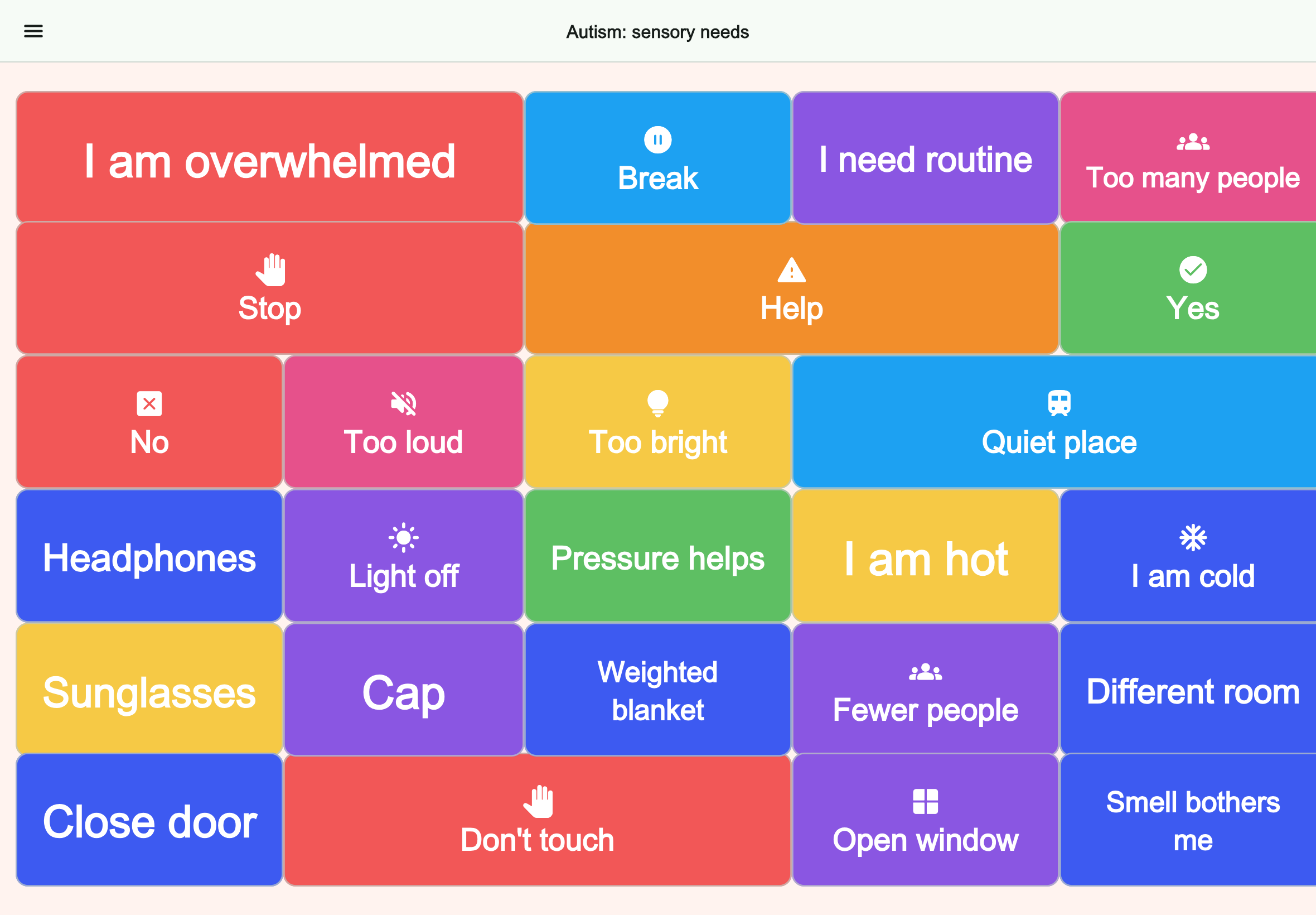
Autism: sensory needs
Makes overwhelm, retreat, and sensory adjustments visible quickly.
Audience: Autism
People searching for an autism communication board app are often looking for something practical and calm. They may need support for routines, transitions, requests, sensory overload, choices, school communication, or everyday situations where speech is limited, inconsistent, or temporarily unavailable.
Talking Buttons can help by offering large, predictable speaking buttons that stay available on phone or tablet. The boards can be simple, visual, and specific to the person using them. That makes the app useful for communication when speech is not available, low-pressure requests, and repeated daily routines.
Typical needs
For many autistic people, the structure of a communication tool matters as much as the words on it. Predictable layouts, repeated button positions, simple categories, and low visual noise can make communication easier. A familiar board can support requests even in moments of stress, fatigue, or sensory overload.
It is also common to need different boards for different environments. Home, school, therapy, travel, care, and community outings may all call for different phrases or different levels of complexity.
Why Talking Buttons fits
Talking Buttons supports custom boards with text, icons, colors, and photos. That makes it easier to adapt the app to an individual communication style. Some people may prefer very few buttons with strong contrast. Others may benefit from clear category boards that separate feelings, activities, sensory needs, and daily requests.
Because the app works offline after installation, it can also stay reliable during transport, in public spaces, in classrooms, or in waiting situations where connectivity should not become another obstacle.
Board ideas
A good autism setup often starts with one board that solves the most frequent friction. That might be a break board, a sensory-needs board, a food and drink board, or a school support board. Once that board works, other routines can be added without overwhelming the person using it.
For some users, a basic needs board plus a routine board is enough. For others, it makes sense to separate home, school, therapy, and travel into different boards with stable wording and consistent visual design.
Matching boards
The guides should lead straight to a usable board. The boards below already cover the context described here and can then be adjusted further inside the app.
School and communication support
Makes overwhelm, retreat, and sensory adjustments visible quickly.
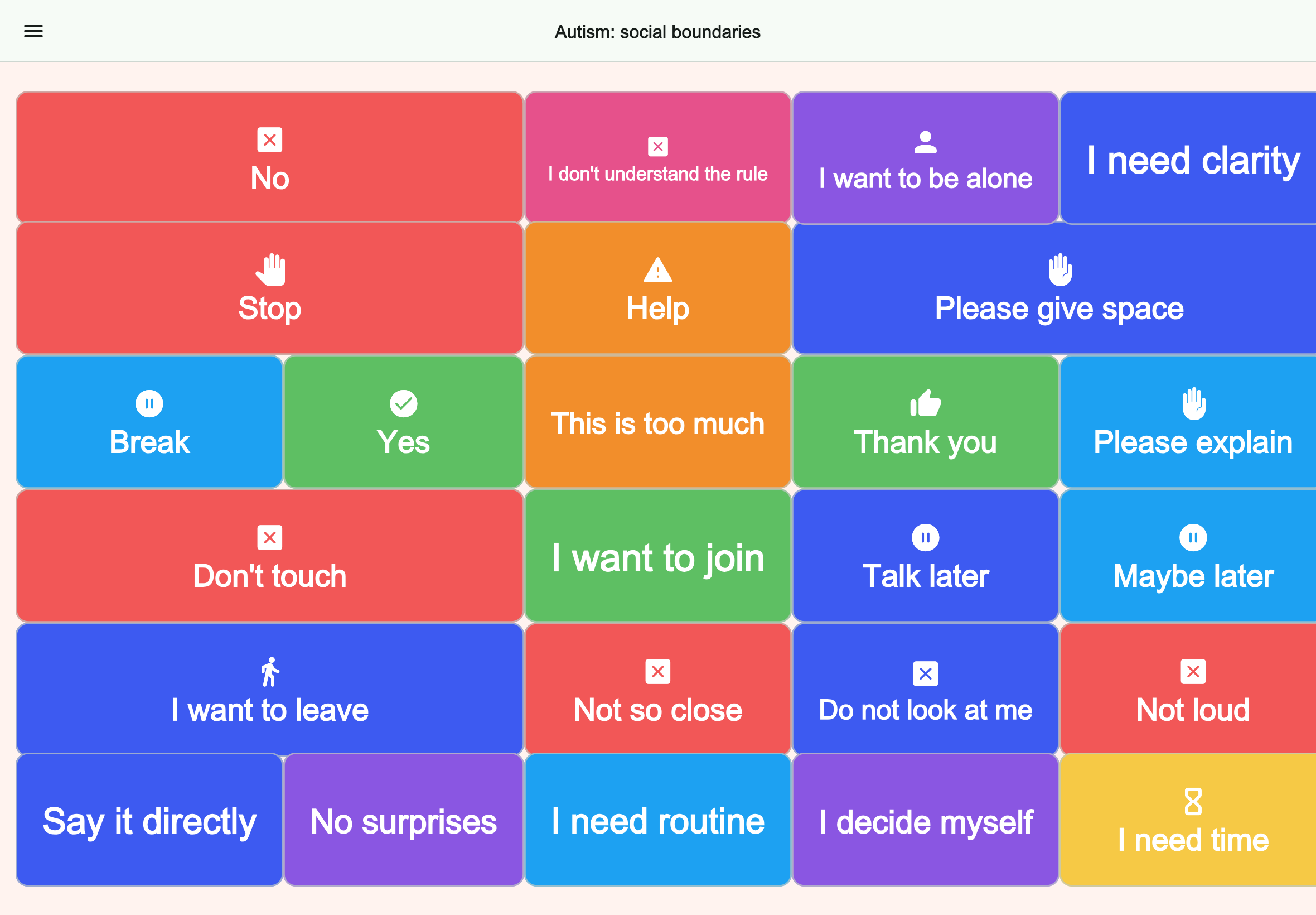
School and communication support
Strengthens distance, breaks, participation, and understandable social rules.

School and communication support
Clarifies help, understanding, task status, and learning areas in class.

FAQ
It can be useful when a person benefits from predictable, customizable speaking boards for routines, requests, choices, and everyday situations.
Yes. You can keep boards very small and focused, which is often helpful when predictability and low visual load matter.
Yes. The app works offline after installation and can be set up with boards for school, transport, waiting situations, and community outings.
Next step
Start Talking Buttons with one practical board for requests, transitions, or daily routines, then expand only when it feels useful.